Grade already fixed by the drawing?
Quote that grade and condition. Request a separate, clearly identified alternative only if the buyer permits an engineering review.
Nickel-copper bar purchasing
For valve components and pump shafts, a quotation for “Monel bar” leaves critical questions unanswered. Confirm the alloy, delivery condition and acceptance documents before comparing price or approving a substitute.
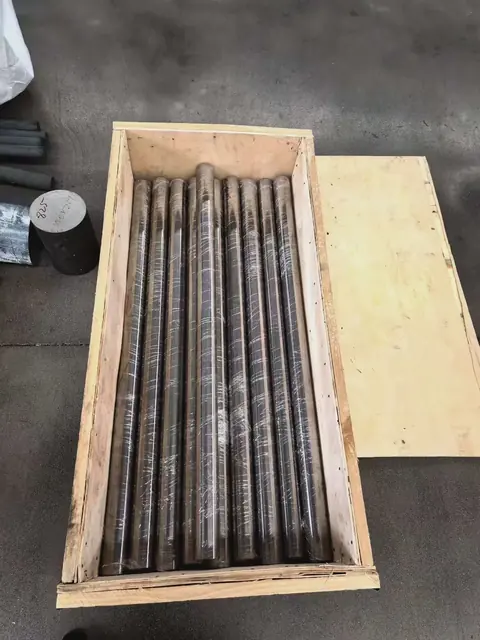 Packing example only. This photograph does not establish the grade or delivery condition of the bars.
Different purchase specifications
Alloy 400 is a solid-solution nickel-copper alloy strengthened by cold work. K-500 contains aluminum and titanium and can be precipitation hardened. Their product names therefore do not establish the same delivered properties. The Special Metals technical bulletins explain these differences; final selection belongs to the responsible engineer.
| Check | Monel 400 | Monel K-500 |
|---|---|---|
| UNS designation | N04400 | N05500 |
| Common bar specification reference | ASTM B164 | ASTM B865 |
| Condition question | Which hot-worked, cold-worked or annealed condition is specified? | Is material required before aging or in the specified age-hardened condition? |
| Offer review | Match condition and test results to the ordered size and specification. | Match condition, heat-treatment evidence and test results to the ordered requirement. |
Use the contractual specification edition and its permitted product forms. Do not transfer a bar standard to sheet, tube or a finished component. Do not approve substitution solely from a similar alloy name or a general strength comparison.
A shaft buyer should identify finished diameter, bearing fits, straightness, surface finish and machining allowance. A valve-component buyer should attach the drawing and identify the part being made. Separate raw-bar requirements from finished-part acceptance so the quotation clearly identifies who performs each operation.
Provide the medium, operating conditions and applicable project specification for engineering review. Special Metals notes that age-hardened K-500 can be more susceptible than alloy 400 to stress-corrosion cracking in some environments. A higher-strength option is not a universal corrosion upgrade. Any sour-service, hardness or project qualification requirement must be stated and reviewed separately.
Quote that grade and condition. Request a separate, clearly identified alternative only if the buyer permits an engineering review.
Ask the engineer to resolve it before a purchase order is released. Have the supplier state the proposed condition and excluded processing in writing.
Use the same grade, specification edition and condition on the RFQ, quotation, purchase order and certificate review checklist. If machining or heat treatment takes place after bar delivery, identify the responsible party and the final verification point. Do not compare an unfinished-material offer directly with an offer that includes additional processing.
For K-500, ask the supplier to identify the delivered condition rather than assuming that all K-500 bar is aged. If an alternative processing route is proposed, obtain approval before ordering and record the associated dimensional and test requirements. Agree whether inspection is before cutting, after processing or at shipment release.
PMI can assist alloy identification; it does not by itself demonstrate the delivered heat-treatment condition or mechanical acceptance. For a wider inspection plan, use the MTC, PMI and third-party inspection guide.
Ask the quotation to separate material readiness, cutting or processing, inspection and packing from transport. A dispatch estimate is different from an arrival commitment. State the named destination, delivery term and required date; request confirmation after specification and document review.
For long bars, define supports, separators, restraint and lifting requirements. For cut blanks, agree piece counts, edge protection and a packing list that matches the labels. State package weight or length limits and any moisture-protection requirement. Request packing photographs when useful, without treating them as material certification.
Alloy: Monel 400 / UNS N04400, or Monel K-500 / UNS N05500: ___
Specification, edition and delivery condition: ___
Drawing revision and permitted substitutions: ___
Diameter, tolerance, length, straightness and surface: ___
Finished-part allowance and cutting responsibility: ___
Quantity by size, piece count and weight basis: ___
Certificate type, tests, witness points and traceability: ___
Post-delivery processing responsibility, if any: ___
Packing, destination, named delivery term and required date: ___
Laixi provides independent sourcing and export coordination. Supply route, documents, quantity and delivery commitments are confirmed in the quotation for the specific requirement.
References checked 16 October 2026. Technical bulletins provide background; the confirmed purchase specification and applicable standard control acceptance.
MONEL is a trademark of the Special Metals Corporation group of companies, used here to identify material grades. No affiliation or endorsement is implied.